


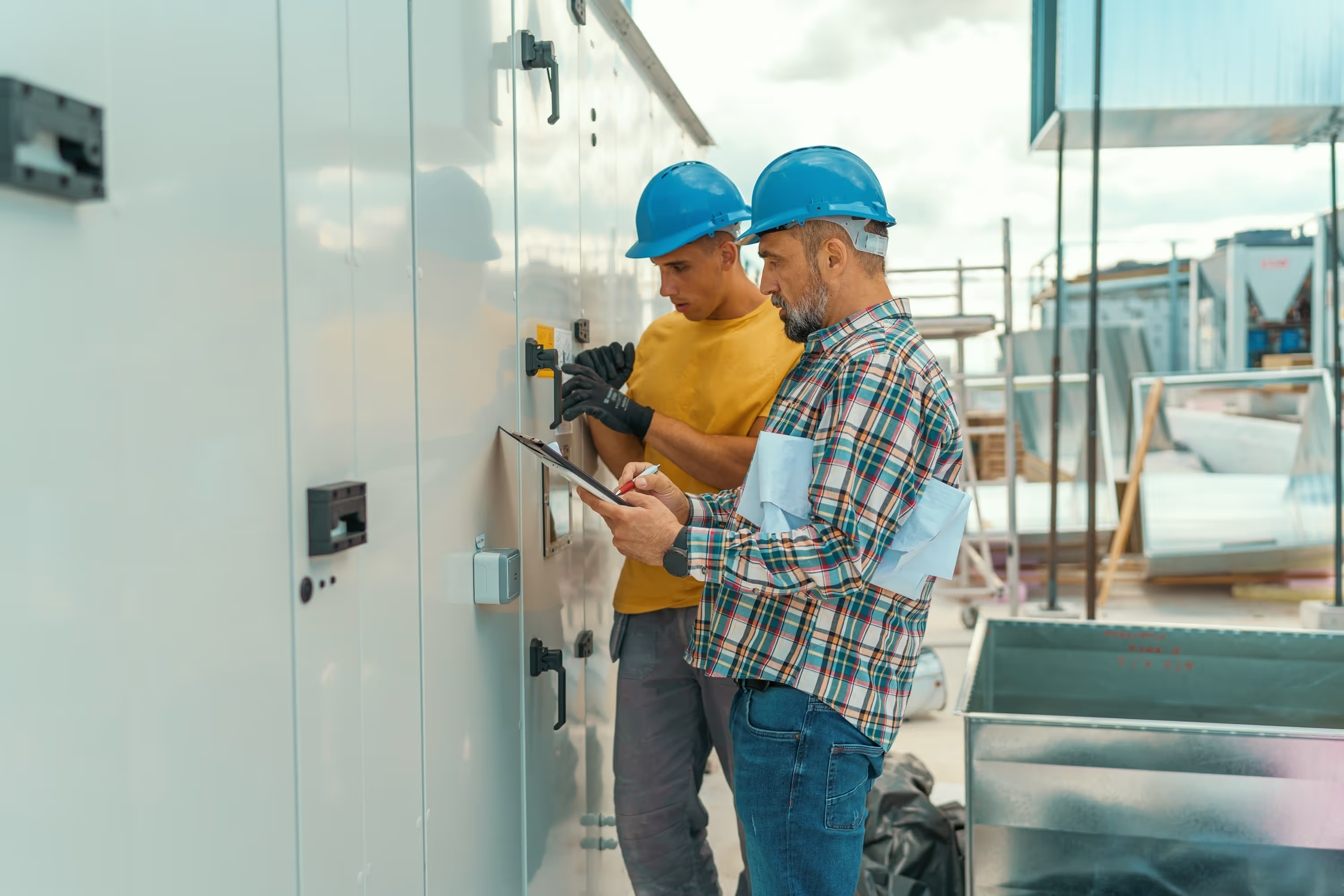


You just spent $85,000 on a new dump truck and excavator for your Chandler contracting business. Your accountant told you to "write it all off" using Section 179, so you took the full deduction on your tax return.
Here's what you didn't realize: You just wasted $32,000 in tax deductions because your business didn't have enough profit to use the entire deduction this year. The excess deduction disappeared—you can't carry it forward, you can't save it for next year, and you'll never get it back.
Meanwhile, your equipment from three years ago needs replacement next year, and you're facing a massive tax bill with no depreciation strategy to offset it.
This scenario plays out constantly with Chandler contractors who work with generic business accountants who understand basic tax preparation but have zero strategic vision for coordinating equipment purchases with multi-year tax planning. These accountants treat Section 179 and bonus depreciation like magic "write off everything" buttons without understanding the strategic implications.
For construction contractors operating equipment-intensive businesses throughout Chandler, Mesa, Gilbert, and Arizona's East Valley, equipment depreciation represents one of the most powerful tax reduction strategies available—but only when implemented strategically as part of comprehensive multi-year planning.
This complete guide reveals everything Chandler contractors need to know about Section 179 vs. bonus depreciation, when to use each strategy, how to coordinate equipment purchases with your tax profile, and the costly mistakes that generic accountants make by treating all equipment deductions identically.
Understanding Equipment Depreciation: The Foundation Every Chandler Contractor Needs
Before comparing Section 179 and bonus depreciation, you need to understand how equipment depreciation works fundamentally and why it matters so much for construction contractors.
Why Equipment Can't Be Deducted Like Regular Business Expenses
When you buy materials for a specific project, you deduct the cost immediately as a business expense. When you purchase fuel for your trucks, you deduct it the year you buy it. But equipment works differently.
The IRS classifies equipment, vehicles, and other long-lived assets as "capital expenditures" rather than ordinary business expenses. The theory is that equipment provides benefit over multiple years, so the tax deduction should spread over the asset's useful life rather than being taken entirely in the purchase year.
Under this standard approach—called Modified Accelerated Cost Recovery System (MACRS) depreciation—your $85,000 equipment purchase would be deducted over five to seven years using specific depreciation schedules. You'd get perhaps $17,000 in deductions the first year, $27,000 the second year, declining amounts in subsequent years.
This spreading of deductions creates a significant tax problem for growing contractors: you need the cash today to buy equipment, but the tax benefit comes slowly over many years, and might arrive in years when you need it less than you do now.
Enter Section 179 and Bonus Depreciation
Congress created Section 179 and bonus depreciation specifically to accelerate equipment deductions, allowing businesses to deduct equipment costs much faster than MACRS depreciation schedules would permit.
These accelerated deduction methods serve important economic policy goals—encouraging business investment, supporting equipment manufacturers, and helping businesses grow by reducing the tax burden of equipment purchases.
For Chandler contractors, these accelerated methods can save tens of thousands of dollars annually when used strategically. But used incorrectly, they waste deductions, create future tax problems, and limit your flexibility in managing tax liability over time.
Section 179: The Immediate Expensing Option
Section 179 allows you to immediately deduct (expense) the full cost of qualifying equipment in the year you purchase and place it in service, subject to specific dollar limits and business income limitations.
The Current Section 179 Limits (2025)
For 2025, you can elect to immediately expense up to $1,220,000 of qualifying equipment purchases under Section 179. This limit is indexed for inflation and increases periodically.
However, this maximum deduction begins phasing out when your total equipment purchases exceed $3,050,000 in a single year. Few Chandler contractors face this phase-out—it primarily affects very large construction companies making massive equipment investments.
The Business Income Limitation: Where Contractors Get Trapped
Here's the critical Section 179 rule that generic accountants miss: Your Section 179 deduction cannot exceed your business taxable income for the year (before the Section 179 deduction itself).
Let's say your Chandler contracting business shows $60,000 in net profit before equipment depreciation. You purchase $85,000 in equipment and want to use Section 179 to immediately expense the full amount.
You can only deduct $60,000 under Section 179—the amount that reduces your taxable income to zero. The remaining $25,000 of Section 179 deduction is wasted; you cannot carry it forward to future years.
Generic accountants often take the full Section 179 deduction on tax returns without checking whether you have sufficient income to use it, creating tax returns showing large losses that provide zero tax benefit.
What Qualifies for Section 179
Section 179 applies to tangible personal property used in your business, including:
- Trucks, vans, and vehicles under 6,000 pounds (with limitations)
- Heavy vehicles over 6,000 pounds gross vehicle weight
- Construction equipment including excavators, loaders, dozers, compactors
- Tools and equipment used in your business
- Computers and business technology
- Office furniture and equipment (if used in your contracting business)
Section 179 does NOT apply to:
- Real property (buildings, permanent structures)
- Property purchased from related parties
- Property held for the production of income (rental property)
- Property used outside the United States
The SUV Loophole: Deducting Vehicles Strategically
Chandler contractors often hear about the "SUV loophole" allowing full deductions for large vehicles. Here's the reality:
Vehicles with gross vehicle weight rating (GVWR) over 6,000 pounds qualify for full Section 179 deduction without the $19,200 limit that applies to lighter vehicles. This includes many pickup trucks, large SUVs, and commercial vans.
However, the vehicle must be used predominantly (more than 50%) for business purposes. For construction contractors, work trucks, service vehicles, and equipment haulers clearly qualify. Personal vehicles used occasionally for business don't qualify for full business use deductions.
Your construction CPA should document business use percentages for all vehicles, ensuring you maximize legitimate deductions while maintaining audit-defensible records.
Bonus Depreciation: The Percentage-Based Acceleration Method
Bonus depreciation works fundamentally differently from Section 179, though contractors often confuse them because both accelerate equipment deductions.
How Bonus Depreciation Works
Under current law, you can deduct 100% of qualifying equipment costs as bonus depreciation in the year you purchase and place the equipment in service. This 100% rate is temporary—it phases down to 80% in 2027, 60% in 2028, 40% in 2029, 20% in 2030, and 0% in 2031 unless Congress extends it.
Unlike Section 179, bonus depreciation has no dollar limit—you can take bonus depreciation on $10 million of equipment purchases if you make them. This makes bonus depreciation particularly valuable for contractors making large equipment investments.
Also unlike Section 179, bonus depreciation has no business income limitation—you can create tax losses using bonus depreciation that can offset other income or carry forward to future years.
What Qualifies for Bonus Depreciation
Bonus depreciation applies to:
- New equipment (purchased new, not used)
- Used equipment acquired and placed in service after September 27, 2017
- Qualified property with recovery periods of 20 years or less
- Construction equipment, vehicles, computers, and machinery
- Qualified improvement property (certain improvements to commercial buildings)
The used equipment provision is particularly valuable for Chandler contractors—you can buy quality used equipment and still take full bonus depreciation, making used equipment purchases much more tax-advantaged than many contractors realize.
Bonus Depreciation and Tax Loss Creation
Because bonus depreciation isn't limited by business income, you can create tax losses that offset your personal income from other sources (subject to passive activity rules for some contractors) or carry forward to offset future years' profits.
This makes bonus depreciation strategically different from Section 179: Section 179 can only reduce current-year business income to zero, while bonus depreciation can create losses providing tax benefits beyond the current year.
However, creating large tax losses might not always be advantageous. If you're anticipating higher tax rates in future years, carrying losses forward might waste deductions you could have used in higher-tax years.
The Strategic Decision Matrix: When to Use Section 179 vs. Bonus Depreciation vs. Regular Depreciation
Generic accountants default to maximum deductions—always using Section 179 or bonus depreciation to expense as much equipment as possible immediately. Construction-specialized CPAs think strategically, selecting depreciation methods based on your multi-year tax profile.
When Section 179 Makes Strategic Sense
Use Section 179 when you have:
Exactly the right amount of income to use the deduction: You're profitable this year and want to reduce taxable income, but don't want to create losses you might not be able to use effectively.
For example: Your Chandler HVAC contracting business shows $180,000 in taxable income. You purchase $150,000 in new service vehicles and equipment. Taking $150,000 Section 179 deduction reduces your taxable income to $30,000, providing substantial tax savings while maintaining some profitable income.
Certainty about this year's tax rate: You know your current year tax rate and believe it's equal to or higher than your likely future rates. Maximizing current-year deductions makes sense when you're confident this is your "high tax rate" period.
No desire to create tax losses: You want to reduce taxes to zero but have no other income to offset with losses and don't want to complicate your tax situation with loss carryforwards.
Simple documentation needs: Section 179 often requires less ongoing documentation than tracking bonus depreciation basis adjustments over multiple years.
When Bonus Depreciation Makes Strategic Sense
Use bonus depreciation when you have:
Very large equipment purchases: You're buying more equipment than your current-year income can absorb through Section 179. Bonus depreciation has no dollar limit and can create losses to carry forward.
For example: Your Chandler excavation contractor business shows $240,000 in taxable income and purchases $420,000 in heavy equipment. Section 179 can only deduct $240,000 (limited by income), but bonus depreciation can deduct the full $420,000, creating $180,000 in losses to carry forward.
Multiple sources of income: You have substantial personal income from other sources (spouse's income, rental properties, investment income) that can be offset by business tax losses created through bonus depreciation.
Expectation of lower future tax rates: You believe tax rates will decline in future years (perhaps you're nearing retirement and anticipate lower income). Creating losses now through bonus depreciation uses deductions at today's higher rates rather than spreading them across future lower-rate years.
Used equipment purchases: You're buying quality used equipment. Bonus depreciation applies equally to new and used equipment, while some contractors mistakenly believe only new equipment qualifies for accelerated depreciation.
When Regular MACRS Depreciation Makes Strategic Sense
Sometimes the best strategy is using standard depreciation schedules without Section 179 or bonus depreciation acceleration. Use regular MACRS depreciation when you have:
Very low current-year income: Your business barely broke even or shows small profit this year, but you expect substantially higher profits in future years. Spreading deductions over multiple years through regular depreciation provides tax benefits in high-income years rather than wasting deductions in low-income years.
For example: Your Chandler contractor business shows just $15,000 in profit after a difficult year. You purchase $80,000 in equipment needed for upcoming projects. Taking $80,000 immediate deduction wastes most of the tax benefit. Instead, using regular MACRS depreciation spreads the deduction over five years, providing tax savings as your profits recover.
Expectation of substantially higher future tax rates: You're in the early growth phase of your business, currently in low tax brackets, but expect to reach much higher brackets as revenue grows. Spreading deductions across future high-bracket years provides more tax benefit than using deductions now.
Bonding capacity concerns: You need strong financial statements to support bonding capacity, and creating large tax losses through accelerated depreciation might weaken your financial presentation to surety companies.
Loan application needs: You're seeking bank financing and need to show strong profitability. While you could show different numbers to banks than you report for taxes, using moderate depreciation creates consistent, strong financial statements across all purposes.
The Multi-Year Equipment Replacement Strategy: Coordinating Depreciation with Business Planning
The most sophisticated approach to equipment depreciation doesn't just optimize each year individually—it coordinates equipment purchases and depreciation strategies across your entire three-to-five-year business cycle.
Building Your Equipment Replacement Schedule
Strategic Chandler contractors maintain formal equipment replacement schedules showing planned equipment purchases over the next five years based on:
Equipment Age and Condition: Document your current equipment inventory with purchase dates, current condition ratings, and projected replacement timing based on typical equipment lifespans.
For example: Your 2016 dump truck has 120,000 miles and shows signs of needing major repairs. You project replacing it in 2026. Your 2019 excavator has moderate hours and should last through 2028. Your 2022 service trucks are in excellent condition and won't need replacement until 2029-2030.
Business Growth Projections: Estimate when you'll need additional equipment to support revenue growth. If you're currently running $2.5 million annually and project growing to $4 million over the next three years, you'll need additional trucks, tools, and equipment to support that growth.
Project Pipeline Analysis: Review your upcoming project commitments and identify equipment needs for specific large projects. That $3.2 million commercial project you just won might require specialized equipment you don't currently own.
Technology and Regulatory Changes: Factor in equipment upgrades needed to meet emissions standards, new technology (GPS tracking, telematics), or competitive requirements (newer, more efficient equipment).
Coordinating Equipment Replacement with Tax Projections
With your equipment replacement schedule established, coordinate it with your tax projections:
Project Income for Next Five Years: Work with your construction CPA to project taxable income for each of the next five years based on current backlog, expected project wins, anticipated profit margins, and overhead projections.
Identify High-Tax Years: Look for years where you'll show substantially higher income than normal—perhaps you'll complete several large profitable projects simultaneously, or you'll have unusually high profit margins.
Identify Low-Tax Years: Find years where income might be lower—maybe you're transitioning to larger projects with longer completion cycles, or you're investing heavily in business infrastructure.
Align Equipment Purchases with Tax Need: Whenever possible, accelerate equipment purchases into high-income years where depreciation deductions provide maximum benefit. Delay equipment purchases (if operationally feasible) out of low-income years where deductions would be wasted.
The Strategic Example: Five-Year Integrated Planning
Let's see how this works for a Chandler general contractor with $3.2 million in annual revenue:
Year 1 (2025): Projected income $380,000 (high year due to several profitable projects completing)
- Equipment needs: Dump truck replacement ($65,000), skid steer replacement ($45,000)
- Strategy: Accelerate both purchases into 2025 using bonus depreciation ($110,000 deduction)
- Result: Taxable income reduced to $270,000, saves approximately $33,000 in taxes
Year 2 (2026): Projected income $180,000 (lower year due to project timing)
- Equipment needs: Service van replacement ($48,000)
- Strategy: Use regular MACRS depreciation (first-year deduction approximately $9,600)
- Result: Preserves most deduction for future years when income will be higher
Year 3 (2027): Projected income $420,000 (high year with major project completions)
- Equipment needs: Excavator replacement ($180,000), trailer ($22,000)
- Strategy: Use bonus depreciation on both ($202,000 immediate deduction) - note bonus depreciation rate drops to 80% in 2027, so deduct $161,600 immediately
- Result: Taxable income reduced to $258,400, saves approximately $48,000 in taxes
Year 4 (2028): Projected income $210,000 (moderate year)
- Equipment needs: Two crew trucks ($95,000 combined)
- Strategy: Use Section 179 for full immediate deduction (income is sufficient to absorb deduction)
- Result: Taxable income reduced to $115,000, saves approximately $28,500 in taxes
Year 5 (2029): Projected income $280,000 (moderate-high year)
- Equipment needs: Equipment trailer ($28,000), tools and small equipment ($35,000)
- Strategy: Use Section 179 for immediate deduction ($63,000 total)
- Result: Taxable income reduced to $217,000, saves approximately $18,900 in taxes
Five-Year Total Tax Savings: Approximately $128,400 in tax savings through strategic equipment depreciation coordination vs. approximately $102,000 had the contractor simply deducted everything immediately without strategic timing—a $26,400 improvement through strategic planning.
More importantly, the contractor maintains operational equipment throughout the planning period while maximizing tax benefit of replacement purchases.
The Costly Mistakes Generic Accountants Make with Equipment Depreciation
Let's examine the specific ways generic business accountants fail Chandler contractors on equipment depreciation strategy.
Mistake #1: Always Maximizing Current-Year Deductions
Generic accountants default to maximum deductions every year without considering whether that strategy actually benefits you. They reflexively apply Section 179 or bonus depreciation to every equipment purchase, congratulating themselves for "saving you taxes."
The result: You waste deductions in low-income years, create unusable tax losses, and have no depreciation deductions available in high-income years when you need them most.
The Real Cost: A Chandler HVAC contractor making $75,000 in equipment purchases in a year where the business only shows $30,000 in profit loses $45,000 in Section 179 deductions that disappear forever. If that contractor shows $220,000 in profit the following year, they have minimal depreciation deductions available and pay unnecessary taxes.
Mistake #2: Ignoring Bonus Depreciation Phase-Down
Bonus depreciation currently allows 100% immediate deduction but phases down to 80% in 2027, 60% in 2028, continuing down to 0% by 2031 (unless Congress extends it).
Generic accountants don't factor this phase-down into equipment purchase timing recommendations. They might suggest delaying equipment purchases into next year without realizing you'll lose 20% of the available deduction by waiting.
The Real Cost: A Chandler contractor delays $200,000 in equipment purchases from 2026 to 2027 for operational reasons. The accountant doesn't flag that bonus depreciation drops from 100% to 80%, costing $40,000 in lost deductions (20% of $200,000). That's approximately $12,000 in unnecessary taxes paid.
Mistake #3: Missing Qualified Improvement Property Opportunities
Generic accountants often miss opportunities to use bonus depreciation on qualified improvement property—improvements to commercial buildings' interiors including electrical, HVAC, plumbing, fire protection, and security systems.
Chandler contractors who own their business facilities can use bonus depreciation on building improvements made after the building was first placed in service, creating substantial tax deductions that generic accountants never identify.
The Real Cost: A Chandler contractor spends $85,000 upgrading their shop facility with new electrical, HVAC, and LED lighting. Generic accountant treats this as building improvement requiring 39-year depreciation (first-year deduction approximately $2,180). Construction CPA identifies it as qualified improvement property eligible for 100% bonus depreciation ($85,000 first-year deduction), saving approximately $25,000 in current-year taxes.
Mistake #4: No Multi-Year Planning Coordination
Perhaps the biggest failure: generic accountants never develop multi-year equipment replacement schedules coordinated with tax projections. They react to each year's equipment purchases independently without strategic vision for optimizing deductions across your business cycle.
The Real Cost: A Chandler contractor pays $15,000-$22,000 more annually in taxes than necessary by making equipment purchase and depreciation decisions year-by-year rather than implementing integrated multi-year strategy. Over a ten-year period, this random approach costs approximately $170,000-$210,000 in unnecessary taxes.
Special Considerations for Chandler Contractors: Arizona-Specific Factors
Arizona's unique business environment creates specific equipment depreciation considerations for Chandler contractors.
Arizona's Summer Construction Season Impact
Arizona's intense summer heat affects construction schedules, creating seasonal revenue patterns. Many Chandler contractors show higher revenues and profits in spring and fall when weather permits comfortable outdoor work, with slower summers and winters.
This seasonality affects equipment purchase timing—you want major equipment purchases to hit in years when annual income will be highest, not just in quarters when you happen to have cash available.
Your construction CPA models your seasonal patterns and helps you time equipment purchases to maximize tax benefit while maintaining operational capability.
East Valley Growth and Equipment Capacity
Chandler's explosive growth as part of Arizona's East Valley means contractors often face rapidly increasing equipment needs. As Chandler, Gilbert, Mesa, and Queen Creek continue substantial residential and commercial development, contractors need equipment capacity to capture growth opportunities.
This growth environment makes equipment planning even more critical—you need to invest in equipment to capture market opportunities, but you also need to do it tax-efficiently rather than haphazardly responding to immediate needs.
Arizona TPT (Transaction Privilege Tax) Considerations
When you purchase equipment in Arizona, you pay TPT on the purchase price. This TPT is not separately deductible—it's included in the equipment's depreciable basis.
However, proper accounting ensures TPT paid on equipment purchases is captured in the equipment cost rather than being deducted as an operating expense, maximizing your depreciation base.
Generic accountants sometimes misclassify TPT, reducing your depreciation deductions while incorrectly expensing TPT separately. Construction-specialized bookkeeping ensures proper treatment.
Used Equipment Market in Arizona
Arizona's large construction market creates an active used equipment market. Chandler contractors can often find quality used equipment locally at substantial savings compared to new equipment prices.
Remember that bonus depreciation applies to used equipment purchased after September 27, 2017, making used equipment purchases much more tax-advantaged than many contractors realize. Don't assume you need to buy new equipment to get full tax benefits.
Coordinating Equipment Depreciation with Other Tax Strategies
Strategic equipment depreciation doesn't exist in isolation—it coordinates with your comprehensive tax reduction strategy.
Depreciation and S-Corporation Optimization
Most Chandler contractors with significant revenue operate as S-Corporations to minimize self-employment taxes. Equipment depreciation affects your S-Corporation strategy in specific ways:
Reasonable Compensation Considerations: S-Corporation owners must take "reasonable compensation" as W-2 wages. When calculating what's reasonable, accountants consider your company's profitability. Higher profits might suggest higher reasonable wages, but equipment depreciation reduces paper profits, potentially supporting lower wage requirements and higher owner distributions (which avoid self-employment tax).
Your construction CPA coordinates equipment depreciation strategy with S-Corporation wage planning, optimizing both simultaneously.
Depreciation and Retirement Plan Contributions
Equipment depreciation reduces your business taxable income, which affects retirement plan contribution opportunities in specific ways:
Solo 401(k) Contributions: If you operate without employees, Solo 401(k) contribution limits are based on your business income. Using extensive depreciation to reduce income to very low levels might limit retirement contributions you could otherwise make.
Your construction CPA balances equipment depreciation strategy with retirement planning goals, ensuring you get maximum retirement contributions while still optimizing taxes.
SEP-IRA and SIMPLE IRA Considerations: Similar coordination applies to other retirement plans—reducing business income too dramatically through equipment depreciation might limit beneficial retirement contributions.
Depreciation and QBI (Qualified Business Income) Deduction
The 20% Qualified Business Income deduction available to pass-through businesses interacts with equipment depreciation in complex ways:
QBI Calculation: Your QBI deduction calculates based on qualified business income after depreciation deductions. Using extensive depreciation reduces QBI, which reduces your QBI deduction.
However, in many cases, the direct tax benefit of equipment depreciation exceeds any QBI deduction reduction, making full depreciation still optimal.
Your construction CPA models these interactions, determining optimal depreciation strategies considering all tax implications.
Implementing Strategic Equipment Depreciation: The Step-by-Step Process
Chandler contractors ready to implement strategic equipment depreciation rather than random year-by-year approaches should follow this systematic process:
Phase 1: Equipment Inventory and Assessment (Month 1)
Document your complete current equipment inventory:
- All vehicles with year, make, model, current mileage/hours, condition rating
- All construction equipment with specifications, age, condition, current usage levels
- All tools and smaller equipment with replacement cost estimates
- Current total equipment value and age distribution
Assess each equipment item's projected replacement timing based on age, condition, usage intensity, and your operational requirements.
Phase 2: Multi-Year Business Projections (Months 1-2)
Work with your construction CPA to develop five-year business projections including:
- Expected annual revenues based on current backlog and anticipated growth
- Projected profit margins by year considering market conditions and operational efficiency
- Anticipated major equipment needs based on business growth and replacement schedules
- Tax liability projections under various scenarios
These projections form the foundation for strategic equipment purchase timing.
Phase 3: Strategic Equipment Replacement Schedule (Month 2)
Create a formal five-year equipment replacement schedule showing:
- Year-by-year planned equipment replacements based on Phase 1 assessment
- Equipment additions needed to support growth projections from Phase 2
- Estimated equipment costs using current pricing with inflation adjustments
- Flexibility indicators showing which purchases can be accelerated or delayed
This schedule isn't a rigid mandate—it's a planning tool allowing strategic decisions about timing.
Phase 4: Depreciation Strategy Development (Month 3)
Your construction CPA develops depreciation strategies for each year's projected equipment purchases, selecting Section 179, bonus depreciation, or regular MACRS based on:
- Projected income levels each year
- Other tax considerations (retirement contributions, S-Corp wages, QBI)
- Cash flow needs and banking relationship considerations
- Multi-year tax rate expectations
This creates your integrated equipment and tax strategy.
Phase 5: Ongoing Implementation and Adjustment (Ongoing)
Implement your strategy each year, making adjustments as circumstances change:
- Review actual results quarterly against projections
- Adjust equipment purchase timing based on actual income levels
- Modify depreciation strategies if income differs substantially from projections
- Update five-year plan annually based on actual results and revised projections
This ongoing process ensures your equipment depreciation strategy remains optimized as your business evolves.
How Whyte CPA Implements Strategic Equipment Depreciation for Chandler Contractors
At Whyte CPA, we've developed comprehensive systems specifically designed to help Chandler contractors maximize tax benefits from equipment investments while supporting business growth.
Our Equipment Depreciation Planning Process:
Phase 1: Current Situation Assessment We analyze your existing equipment inventory, review historical equipment purchase patterns, and assess your current depreciation strategies, identifying opportunities you've missed and problems in your current approach.
Phase 2: Multi-Year Business Modeling We develop detailed five-year business projections incorporating your growth plans, project pipeline, and market conditions, creating the foundation for strategic equipment planning.
Phase 3: Equipment Replacement Strategy We work with you to develop comprehensive equipment replacement schedules coordinating operational needs with tax optimization opportunities.
Phase 4: Integrated Tax Planning We coordinate your equipment depreciation strategy with all other aspects of your tax reduction plan, including S-Corporation optimization, retirement planning, and overall income management.
Phase 5: Ongoing Optimization We provide quarterly reviews adjusting your strategy based on actual results, upcoming equipment needs, and changes in tax law or business conditions.
Our Construction-Specific Advantage:
Unlike generic business accountants who handle your equipment depreciation reactively (you buy equipment, they depreciate it), we provide proactive strategic planning:
- We anticipate your equipment needs based on business growth projections
- We coordinate equipment purchase timing with projected income levels
- We select optimal depreciation methods based on multi-year analysis
- We model various scenarios showing tax impacts of different approaches
- We adjust strategies quarterly based on actual performance
This integrated approach typically saves Chandler contractors $15,000-$45,000 annually compared to reactive depreciation strategies—and the savings compound over time as equipment replacement cycles repeat strategically rather than randomly.
Common Questions Chandler Contractors Ask About Equipment Depreciation
Q: Can I change depreciation methods after I file my tax return?
Generally no. Once you file your tax return for the year you placed equipment in service, your depreciation method election is locked. You cannot later amend to change from regular depreciation to Section 179 or bonus depreciation.
This is why proactive planning with a construction CPA is critical—you need to select optimal depreciation methods before filing, not after realizing you should have done something different.
Q: What if I sell equipment before it's fully depreciated?
When you sell equipment, you have gain or loss based on the difference between your sale price and your remaining tax basis (original cost minus accumulated depreciation).
If you used Section 179 or bonus depreciation to immediately expense equipment, your tax basis is very low, potentially creating substantial gains when you sell. These gains might be taxed as ordinary income rather than capital gains, creating tax surprises if not planned properly.
Strategic contractors plan for equipment disposals, coordinating sales timing with income levels and depreciation strategies to minimize overall tax impact.
Q: Do I have to use the same depreciation method for all equipment purchased in a year?
No. You can elect different depreciation methods for different equipment purchased in the same year. You might use Section 179 for some equipment, bonus depreciation for other equipment, and regular MACRS for still other equipment—all in the same tax year.
This flexibility allows optimal strategy for your specific situation, using accelerated methods where they provide maximum benefit and slower methods where appropriate.
Q: Can I take Section 179 or bonus depreciation on equipment I bought used?
Yes. Bonus depreciation applies to both new and used equipment (acquired and placed in service after September 27, 2017). Section 179 applies to both new and used equipment as well.
This makes used equipment purchases particularly attractive for Chandler contractors—you save money on the purchase price while still getting full accelerated depreciation benefits.
Q: What happens to my depreciation deductions if I close my business?
If you close your business while owning partially-depreciated equipment, you may have gain or loss when you dispose of the equipment. Unused depreciation deductions don't carry forward to future activities or to your personal return—they're lost when the business activity ends.
This is one reason why strategic depreciation timing matters so much—you want to use depreciation deductions while you can benefit from them.
Q: Should my equipment be owned by my operating company or a separate entity?
Some Chandler contractors operate with separate equipment-holding companies that lease equipment to their operating companies. This structure can provide asset protection and tax benefits in specific situations.
However, it adds complexity and requires proper documentation of lease arrangements, fair market rental rates, and formal business substance. Your construction CPA should analyze whether this structure benefits your specific situation considering your asset protection needs, tax profile, and administrative capabilities.
Q: How does financing equipment affect depreciation deductions?
Financing equipment doesn't change your depreciation deductions—you still depreciate based on the full purchase price, even though you're making payments over time.
However, financing does affect your cash flow, which should factor into equipment purchase timing decisions. Don't delay beneficial equipment purchases simply because you'd need to finance them—the tax savings from strategic depreciation often justify financing costs.
Take Action: Implement Strategic Equipment Depreciation Planning
You're making substantial equipment investments every year—$75,000, $150,000, perhaps $300,000 or more in trucks, excavators, tools, and construction equipment essential to your Chandler contracting business.
Every equipment purchase you make without strategic depreciation planning potentially wastes $15,000-$30,000 or more in tax deductions used inefficiently, missed opportunities, and poor coordination with your overall tax strategy.
The contractors winning the equipment depreciation game aren't lucky—they're strategic. They work with construction-specialized CPAs who understand that equipment depreciation is a multi-year chess game, not a simple "deduct everything immediately" reflex.
Get Your Equipment Depreciation Strategy Assessment:
Schedule a consultation with Whyte CPA and we'll analyze:
- Your current equipment inventory and replacement needs
- Historical patterns showing where you've wasted depreciation deductions
- Your projected five-year equipment replacement schedule
- Optimal depreciation strategies for your specific situation
- The potential annual tax savings from implementing strategic approaches
During this assessment, we'll review your recent tax returns, discuss your equipment needs, and provide specific recommendations for optimizing depreciation timing and method selection.
What You'll Learn:
- Exactly how much you've been losing through poor depreciation strategy
- Your optimal five-year equipment replacement and depreciation plan
- How to coordinate depreciation with S-Corporation, retirement planning, and other tax strategies
- Specific equipment purchase timing recommendations for maximum tax benefit
- The ROI of strategic depreciation planning for your business
The Investment in Strategic Equipment Tax Planning:
Chandler contractors working with Whyte CPA for comprehensive tax planning typically invest $1,200-$2,200 monthly for services including:
- Multi-year tax projection and planning
- Strategic equipment depreciation coordination
- Monthly bookkeeping tracking equipment basis and depreciation
- Quarterly tax planning reviews adjusting strategies based on results
- Year-end business tax preparation with optimal depreciation elections
This investment routinely delivers 5X-15X return through optimized equipment depreciation alone, before considering all the other tax reduction strategies we implement simultaneously.
Don't continue buying $100,000+ in equipment annually while wasting $20,000-$40,000 in depreciation deductions through poor timing and strategy.
Book your equipment depreciation strategy assessment today, or call (480) 490-7244 to speak with our construction tax planning team.
About Whyte CPA PC
Whyte CPA PC specializes in providing comprehensive accounting and tax services for construction contractors throughout Arizona's East Valley region, including Chandler, Gilbert, Mesa, Phoenix, Scottsdale, and Tempe.
We understand the unique tax planning requirements for equipment-intensive construction businesses, including strategic depreciation timing, Section 179 vs. bonus depreciation optimization, multi-year equipment replacement coordination, and integration with S-Corporation, retirement planning, and overall tax reduction strategies. Our proactive planning approach helps Chandler contractors save $15,000-$45,000+ annually through optimized equipment tax strategies.


